Australian Pelican
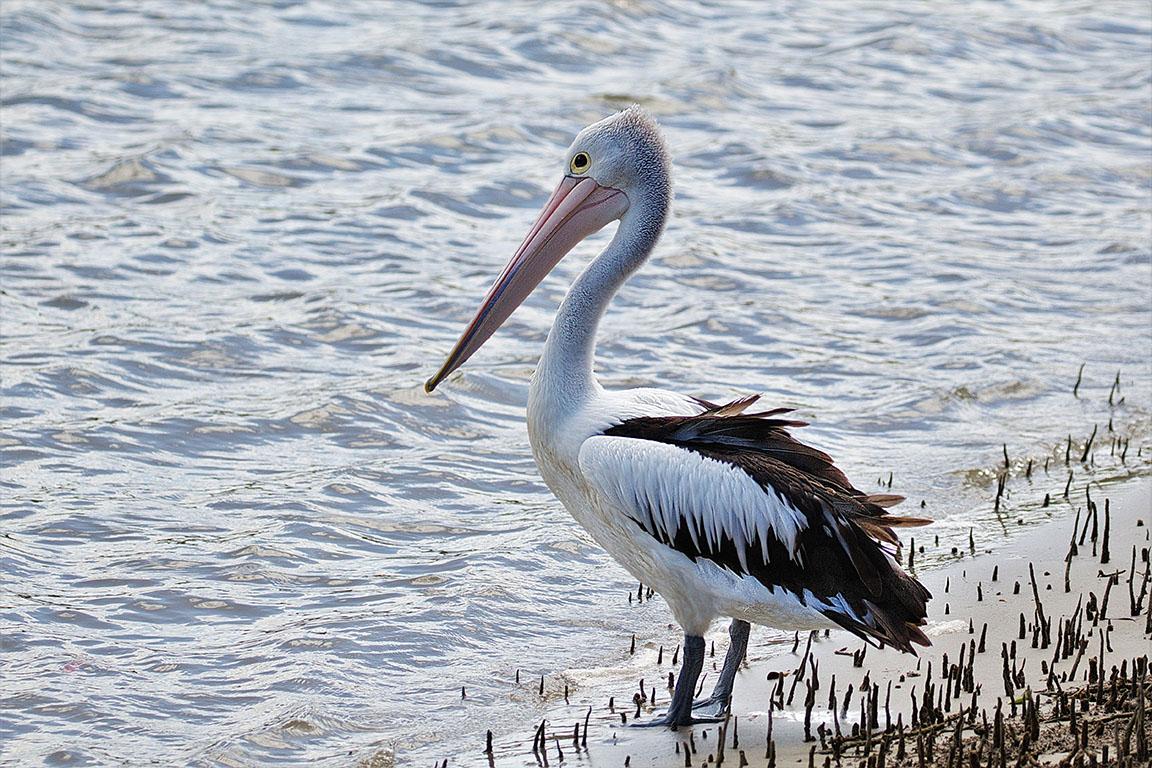
Beree-Badalla Reserve, Gold Coast
The Austalian pelican is found on inland and coastal waters in Australia, New Guinea, Fiji and parts of Indonesia.
Habitat
Australian pelicans prefer substantial areas of open water such as large lakes, reservoirs, rivers, estuaries, lagoons and drainage channels. They avoid human contact during the breeding season. They roost in a variety of habitats including beaches, mudflats and reefs.
Feeding
Australian pelicans plunge dive from the surface of the water and may cooperate in groups to herd fish into shallow water. Fish is their main prey but they will also catch crustaceans, insects, shrimps, reptiles, amphibians and small mammals. They also hunt other birds and their young and eggs including silver gulls, ibis and teal.
Breeding
Pelicans breed in large colonies. The nest is a shallow scrape in sand or earth which is sometimes lined with grass. One to four chalky-white eggs are incubated by both parents who also share chick raising. The parents give larger chicks feeding preference and the smaller ones die of starvation or siblicide.
Wildfile Specials
- The Austalian pelican has the longest recorded bill in the bird world.
- 30 million year old pelican fossils have been found in France. They have evolved relatively little since that time.
- Australian pelicans often kill other birds by holding them under the surface of the water and drowning them.
- Adult pelicans may cannibalise young pelicans.
- Aborigines regard pelicans as sacred.
- The South Australian Wangkamura tribe believe pelicans created opals and fire.